


How Acne Tower Works
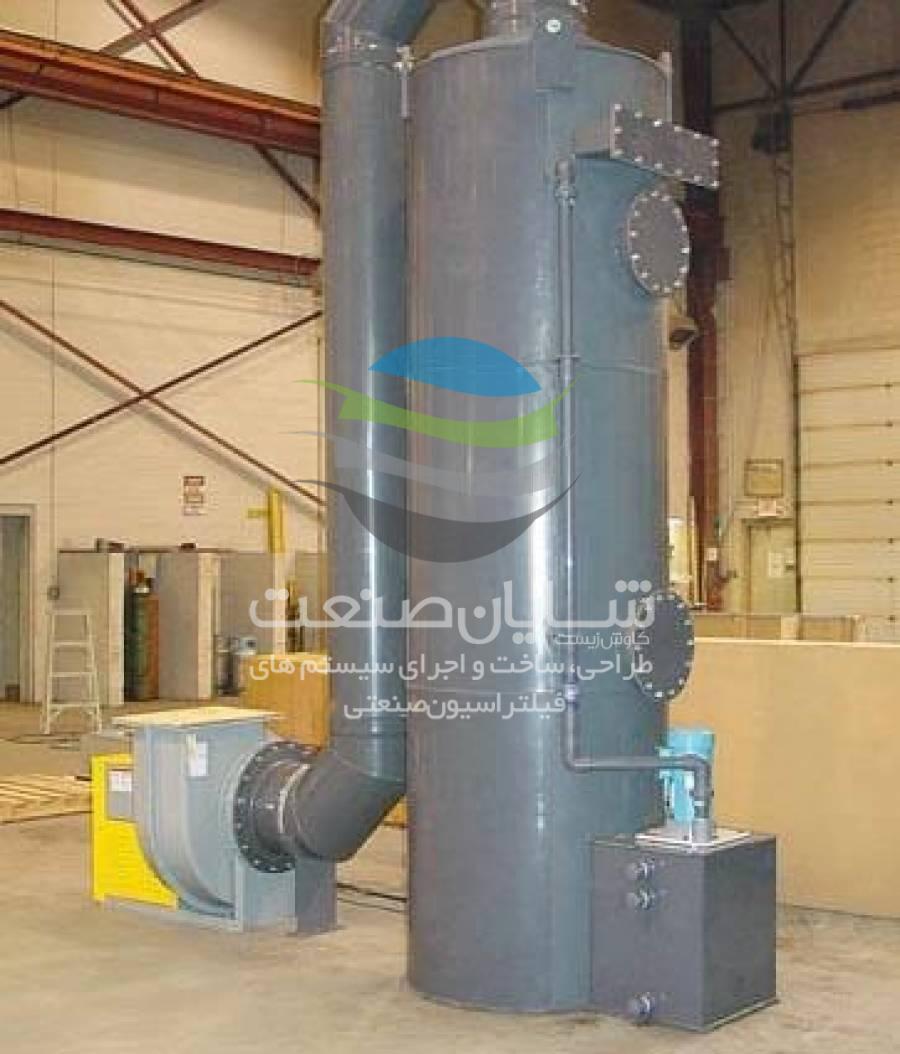
There are different methods for separating the components of a solution, one of which is the distillation process. In the distillation method, the separation of the components of a mixture is done based on the difference in their boiling points. Distillation in practice is done in the following two ways. The first method involves producing steam by boiling a mixture of liquids, then steam condensate, without any liquid returning to the distillation chamber. As a result, there is no return fluid. In the second method, part of the liquefied steam is returned to the distillation apparatus and this returning liquid is placed next to the steam that goes to the refrigerant. Each of these methods can be continuous or discontinuous.
Types of distillation
Simple distillation
The solution components of a solution of an inactive solute can be separated by simple distillation. To do this, boil the solution to evaporate the solvent, evaporate and separate from the dissolved substance. By cooling the vapor (condensate), the liquid solvent is collected and the dissolved substance remains as a distillation residue.
Fractional distillation
The performance of the solution constituent, which consists of two volatile components that follow Raoult’s law, can be separated by a fractional distillation process. According to Raoul’s law, the vapor pressure of a solution is equal to the sum of its constituent vapor components, and the share of each component is equal to the product of the molar fraction of that component at its vapor pressure in a particular case.
Simple continuous distillation
In this method, the initial mixture (device feed) is continuously heated in a heater with a constant amount per unit time to evaporate some of it, and as soon as it enters the distillation column, the light component of the steam mixture is separated from the heavy component. It comes out of the top of the distillation column and after passing through the condensers, it becomes a liquid. The heavy part also comes out of the bottom of the distillation column. It should be noted that the light component always has some heavy component and the heavy component also has some light component
Simple non-continuous distillation
In this distillation method, the mixture is heated to boiling point. The vapors that are formed are rich in the light component of the mixture. After passing through the condensers (condensers), they become liquid and leave the distillation system. As the concentration of the heavy component in the residual liquid increases, its boiling point gradually increases. In this way, at each moment of the distillation process, the composition of the resulting vapor phase and the residual liquid changes.
The process of fractional distillation
Fractional distillation is performed in the column with a tray or filled distillation, in which the resulting vapors move from the bottom to the top of the column, and with the liquid phase from the condensate of the previous vapors produced along the column and The downstream is flowing, in contact, thus establishing complete contact between the gas and liquid phases. The temperature of each lower tray is lower, and in the distillation column, the temperature decreases from bottom to top. Vapors whose condensate is equal to the temperature of the tray, on which the tray turns into a liquid, collects on it, and pours onto the bottom tray. As a result, the vapor phase, which is rich in the light component, is released from the top of the column, and the liquid phase, which is rich in the heavy component, is collected from the bottom. Vapors released from the top of the column are converted to liquid in condensers and collected as a product. Usually some of this collected liquid is returned to the distillation column as a return liquid to control the temperature. The upper part of the distillation column up to the tray on which the feed is poured is called the “column separation” area and the lower part of the feed column is called the “stripping” area.
Evaporative distillation (sudden)
When we heat a multi-component solution such as crude oil, its components evaporate faster in order to be lighter. Conversely, when we try to cool these vapors and liquefy them again, whichever is lighter liquefies later. Due to this property, we can distill crude oil in another way which is called “instant distillation”. In this method, we heat the crude oil so that all its components suddenly turn to steam and then we cool them to liquefy. Here, the vapors liquefy in order of heaviness, that is, the heavier they are, the sooner they liquefy, thus separating the crude oil components in order of liquefaction.
Azeotropic distillation
This distillation method is usually used in cases where the boiling points of the mixture components are close to each other. Separation of the initial mixture is possible by increasing a specific 89879 solvent that forms an azeotope with one of the key components. The azeotrope forms the distillate or residue from the column and then separates the solvent and the key component. Often, the additive forms a low boiling point azeotropy called brittle azeotrope. Azeotropes often contain feed components, but the ratio of key components to other feed components is very different and higher.
An example of azeotropic distillation is the use of benzene to completely separate ethanol from water, which forms a low boiling point azeotropy with 95.6% by weight of alcohol. The water-alcohol mixture with 95% by weight of alcohol is added to the azeotropic distillation column and a benzene-rich stream flows from the upper part. The alcohol residue is almost pure and the upper vapor is a triple azeotropy. This liquefied vapor is divided into two phases. The organic layer is returned, the organic layer is sent to the benzene recycling column. All benzene and the amount of alcohol taken in the high vapor are taken to the first column. The end stream is distilled in the third column to obtain pure water and some double azeotropes.
Distillation in vacuo
Due to the fact that the boiling point of heavy petroleum materials is relatively high and requires more temperature and energy, and on the other hand, the resistance of these materials to high heat is lower and decomposes faster, so a relative vacuum is used to separate them. In this case, the material boils at a temperature lower than its normal boiling point. As a result, vacuum distillation has two benefits: first, it requires less energy and temperature, and second, it does not break down molecules. Today, in most cases, vacuum is used in distillation. That is, they perform both fractional and instantaneous distillation in a vacuum.
Distillation towers
In general, the distillation tower consists of 4 main parts:
1. Tower
2. Reboiler
system 3. Condenser
4. Peripheral equipment includes: various control systems, intermediate heat exchangers, pumps and collection tanks the product.
Tower
In general, towers used in the industry for distillation are divided into two main categories:
1. Tray
towers 2. Packed towers Tray towers based on the type of trays used They are divided into 4 categories:
1. Bubble Cap Towers
2. Sieve Tray Towers
3. Valve Tray Towers
4 Jet Tray Towers
Each of these types of towers has advantages and disadvantages that will be discussed in the following sections.
How a tray tower works
In general, the process that takes place in a tray tower is the act of separating the material. As mentioned, this process is done directly or indirectly.
In the heat source distillation process (Reboiler), it provides the heat needed to perform the distillation and separation of the constituents of a solution. Vapor rising from the tower makes direct contact with the liquid moving from the top of the tower to the trays. This contact raises the temperature of the liquid on the tray and eventually causes the temperature of the liquid to approach the temperature of the bubble. When the liquid reaches the temperature of the bubble, the first vapor particles are gradually produced, which are rich in volatile material (a substance that has a lower boiling point or higher pressure). On the other hand, in the vapor phase, materials that have a lower boiling point Are condensed and move in a liquid phase down the tower. The most important function of a tower is to create a suitable contact surface between the vapor and liquid phases. The higher the contact surface, the higher the separation efficiency.
Feed
The mixture entering the tower, which may be a liquid, gas, or a mixture of liquid and gas, is called a feed. The feed site is usually at a predetermined point in the tower. In tray towers, the feed inlet is called the feed tray. One of the important characteristics of the feed tray is that in terms of temperature and relative composition (molar fraction), the desired component corresponds to the input feed. Of course, the location of the incoming feed also depends on the physical condition of the feed. Usually, if the feed is liquid, it enters the feed tray with the liquid flowing from the top tray. If the feed is in the form of steam, it is usually inserted from under the feed tray, and if the feed is a mixture of liquid and steam, it is better to first separate the liquid and steam phase and then enter the feed into the tower as mentioned. .
Overhead Product
What is received from the tower as the output is called the overhead product, which is usually rich in the component that has the lowest boiling point.
Bottom Product
The material that comes out of the bottom of the tower is called the bottom or end product (Bottom) and will usually be rich in heavier components (which have a higher boiling point).
Reflux Ratio
The ratio of the amount of liquid returning to the tower in terms of mole or weight to the liquid or heater leaving the system as a product is called the return ratio and is denoted by the letter R.
Return ratio and its effects on the operating conditions of the tower
By increasing the return liquid ratio, the number of trays required for separation (tower length) decreases, but in contrast, the condenser and boiling heat load and the amount of steam and liquid along the tower increase. In this case, not only is it necessary to add the required heat levels to them, but also the cross-sectional area of the tower increases due to the increase in liquid and vapor flow.
When the value of R is high, the number of steps and the length of the tower reaches its minimum and the whole overhead product enters the tower as a return fluid, and this state is called total reflux.
If R is at its lowest, the tower length and number of steps will be at their highest, and the separation operation will not be complete. The practical value of R is usually between the full return state and the minimum value of R. In most cases, the amount of liquid returned also affects the temperature of the tower. Usually in a distillation tower, its end temperature is much higher than its low temperature, and this temperature difference will exist along the tower. The amount of return current will be a controlling factor on the system temperature.
Reboiler
Welders, usually located at the end of the tower and next to it, are responsible for providing the heat or energy needed to perform the distillation process.
Welders are usually considered as an equilibrium step in the distillation process and as a tray in tray towers.
Types of welders
The most important types of welders that are widely used in the chemical industry are:
1. Jacketted Kettle
2. Internal Reboiler
3. Kettle
welder 4. Vertical Thermosiphon Reboiler
5 Horizontal Thermosiphon Reboiler
6. Forced Circulation Reboiler
In thermosyphon or natural circulation welders, fluid movement is based on the density difference between hot and cold points. This phenomenon can be done in two ways, which are:
1. Once – Thorugh Reboiler
2. Recirculating Reboiler
Criteria for selecting the appropriate welder
In general, the points that should be considered in choosing a welder are:
1. Transfer speed (minimum level)
2. Necessary space and pipelines
3. Ease of maintenance
4. Tendency to deposit and fluid scaling
5. Fluid residence time In process
6. Operational resilience
7. Operating cost
8. Increasing the amount of steam produced
Each of the welders has advantages and disadvantages that have been collected in reference books. This data can be used for initial design. But in general, the most common and economical
welding used in the chemical and petrochemical industries is the thermosyphon type, especially the horizontal type, which is widely used in distillation systems.
Select the Reboiler type
The choice of Reboiler type depends on the following factors:
1. Physical properties of the fluid, especially viscosity and tendency to fluid deposition
2. Operating pressure (vacuum or pressurized)
3. Equipment placement method and usable space
Advantages of horizontal thermosyphon welders
1. The dimensions of horizontal units are not limited in terms of pipe length and weight, and therefore for large thermal surfaces, the installation of horizontal units is more desirable and easier.
2. Because in horizontal thermosyphon welders, the fluid moves inside the shell, it is preferred in terms of no scale and scaling and ease of maintenance and use.
3. These welders are more flexible in terms of hydraulic design of the permitted liquid surfaces in the system and high round currents can be created in it without any problems.
4. Horizontal thermosyphon welders have less increase in boiling point than the vertical type, and this is an important advantage in certain cases where the fluid is temperature sensitive or the system operates in a vacuum.
Condenser
The role of the condenser is to convert the vapors from the heating operation into a mixture into a liquid. This is called condensate or condensation, and the device in which the operation is performed is called a condenser. In general, condensers are divided into two basic categories:
1. Total Condensers
2. Partial Condensers
If all the steam at the top of the tower is liquefied and part of it enters the tower and the other part enters the collection tank Product Total condensation has been performed. But if part of the vapor is liquefied and the other part comes out of the condenser as steam, it is called a partial condenser. Condenser type selection guide with condenser heat transfer coefficients has been prepared in reference books.
Comparison of stacked towers with sinid towers
In stacked towers, the pressure drop is usually less than in sinid towers. But if there are suspended particles in the inlet fluid of the tower, cinematic towers work better. Because in stacked towers, suspended matter settles and causes clogging and disruption of the liquid flow. If the tower is too medium, the cinnabar tower is better. Because if the diameter of the tower is high in stacked towers, the liquid distribution will not be uniform when moving from the stacked bed.
In cinematic towers, some of the solution can be extracted from the tower in the form of side processes, but in stacked towers, this is not possible. Repair work inside cinematic towers is easier. It will be very costly to clean the stacked towers, as I have to empty them first and then clean them.
Material of accumulating materials
These materials must be such that they do not mix with the fluid inside the tower.
Sturdiness of accumulating materials
The material of the accumulator must be strong enough so that it does not break or deform as a result of use.
How to put the accumulating material
Stacking materials are placed inside the tower in both regular and irregular ways.
Regular filling
One of the advantages of this type of filling is less pressure drop, as a result of which more liquid volume can be passed through it.
Irregular filling
One of the advantages of this type of filling is its low cost. But the vapor pressure drop across the tower will be large.
Stacked towers
Stacked towers use stacking pieces or rings instead of trays. In stacked towers, stacking rings or pieces should be selected and poured into the tower to achieve the following goals.
Creating the highest contact surface between liquid and vapor
Create a suitable space for fluid to pass through the accumulated bed
Compare different types of trays
In the oil industry, various types of trays are used in distillation, separation and adsorption towers. Features that are considered in selecting the type of tray for a particular job are: steam-liquid contact efficiency, tray capacity, vapor drop when passing through the tray, time the liquid stays on the tray, liquid characteristics and…. Because most tray trays are used in industry, they are compared to cap trays to compare the characteristics of other trays.
Distillation towers with valve trays
These types of trays are like mesh trays. The difference is that the sliding valves are located on each duct. In the oil industry, two types of these trays are used:
flexible
As the name implies, the valves can move between two states, very open or very closed.
Additional pages
In this type of trays, there are two valves, one light which is placed on the bottom of the tray and the other heavy which is placed on a tripod. When the steam is low, only the light cover moves. If the amount of steam is more than a certain limit, both valves move.
Distillation towers with lattice trays
In towers with lattice trays, the size of the ducts or networks must be chosen so that the gas pressure can pass the gas through the liquid phase at a suitable speed. An important factor that affects the efficiency of these trays is the way they are placed in the tower. If these trays are not perfectly horizontal, the height of the liquid will not be uniform at the surface of the tray and the passage of gas through all the ducts will not be the same.
Corrosion of metal trays is also very important in this type of trays. Because of the corrosion, the diameter of the holes increases, as a result of which a large amount of steam will pass through the corroded ducts at a low speed. And we know that if the velocity of the gas is less than a certain limit, the liquid will move down the duct and the efficiency of the separation work will decrease.
Different parts of the distillation tower with body cap trays and trays
The body material is usually cast steel. Trays are usually made of cast iron. The spacing of the trays is usually chosen according to the design conditions, the degree of purity and the efficiency of the separation work. In most oil refineries, for distillation towers with a diameter of 4ft50-18 cm. As the diameter of the tower increases, more distance is provided for the trays.
Caps or caps
The caps are made of cast iron. The type of caps is selected according to the type of distillation and their number in each tray depends on the maximum allowable speed of gas passing through the tray. Are placed to prevent the liquid level from falling below the mean level. The height of the liquid surface on the tray should be such that the gases coming out of the slits of the lids can pass through it and the passage time of each bubble will reach the maximum possible. Due to the increase in the passage time of the bubble through the liquid, the contact time between the gas and the liquid is increased, the efficiency of the trays is increased.
Distillation towers with hooded trays
In distillation towers with cap trays, the number of trays in the tower path depends on the type of material transfer and the intensity of separation. The diameter of the tower and the distance between the trays depend on the amount of liquid and gas that passes through a tray per unit time. Each of the tower trays is a separation step. Because on these trays, the gas and liquid phases are placed next to each other and the work of transferring the material from the gas phase to the liquid phase or vice versa is done in each of the trays. In order for the transfer efficiency of the material in each tray to be maximized, the contact time between the two phases and their common surface must be maximized as much as possible.